|


What lessons were learned?
Much has been written about the Battle of the Somme and it has long lain at the heart of controversy. To many the Battle of the Somme represents tragedy and futility. According to this analysis, the Somme was a disaster from start to finish in which many innocent lives were lost due to the stupid and reckless behaviour of the ‘butchering and blundering’ commanders. This popular view, espoused by historians such as A J P Taylor and Alan Clark, went largely unchallenged until other historians such as John Terraine, Paddy Griffith, Gary Sheffield and Peter Simpkins started to publish alternative theories. Although differing in many respects, these historians have argued that the Somme represented an important step forwards in the war and resulted in developments which would ultimately lead to the defeat of Germany.
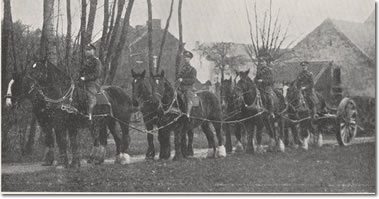 Photograph showing 142 (Durham) Heavy Battery. (DUL ref: Add MSS 1584)
Working together also required a change in tactics as did the circumstances. The Army, faced with thousands of new recruits with no military experience, was forced to standardise training and procedures and placed a greater emphasis on the training of junior officers. Officers were also allowed to take more initiative after the Battle of the Somme. Haig and the other generals accepted that company commanders should be making many tactical divisions and so the platoon rather than the company became the key tactical unit. Tactical developments were not confined to the infantry. In addition to pioneering the use of the ‘creeping barrage’, the artillery also started to develop the techniques of ‘flash-spotting’ (using the flash from the gun muzzles of the enemy to locate enemy positions), sound-ranging (using the sound of the enemy gunfire to calculate their position) and pre-registration (using grid co-ordinates to target the most likely positions for guns). These techniques allowed them to launch bombardments without giving prior warning and proved to be very effective. All branches of the services also benefitted from the development of effective supply lines. Up to and including the Battle of the Somme, supply lines were set up on an almost ad hoc basis but this system of improvisation was near breaking point. After the Somme, a new system of supply was brought in by Sir Eric Geddes. This was based on predicting where supplies would be needed and making sure that lines were quickly established. Again, this proved very successful.
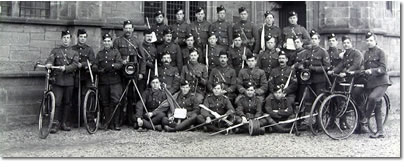 Photograph showing the signalling section of 4 Highland Light Infantry. (DUL ref: Misc Photo Album 2) The revisionist camp see these advances and developments as being part of the learning curve that the British Army had to embrace during the First World War and particularly during and after the Battle of the Somme. Admittedly progress was not smooth and the ride was bumpy but these historians believe that the lessons learned from the Somme helped the British and her allies to defeat the Germans in 1918. 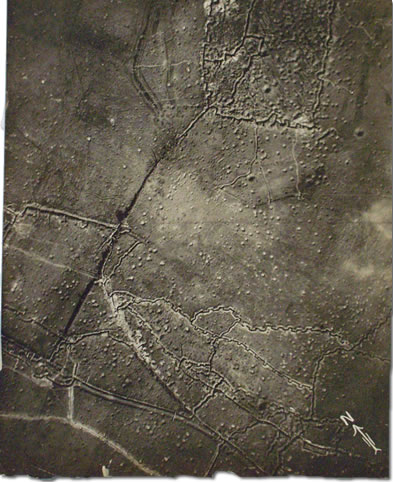 Aerial photograph showing part of the Somme Battlefield. (DUL ref: Lowe Papers, File B1)
According to the revisionist camp, one of the major achievements of the Somme was that it heralded the start of real co-operation and collaboration between the different arms of the armed forces. The artillery and infantry started to combine their attacks, making great use of the ‘creeping barrage’; these two branches were able to work much better because of the reconnaisance work undertaken by the Royal Flying Corps; and much vital work was done by the Engineers and the Signallers. From 1917 the attacks on German defences started to become more successful because of this co-operation. 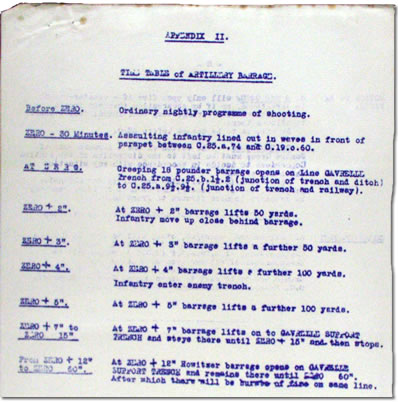 Details of ‘creeping bombardment’ to accompany the attack on Gavrelle Trench (DUL ref: Lowe Papers File B2)
The commanders soon realised that many of the failures in the Battle of the Somme were due to breakdowns in communication. It was incredibly hard getting information to and from the front line despite the efforts of the signallers. After the Somme, signallers were told to follow close behind the forward attack laying their lines in a ladder formation so that if one part of the line was broken, messages could still get through. This was a major development. Greater use was also made of intelligence. Aerial reconnaissance photographs proved very useful as did the intelligence reports from the airborne spotters. |


