
The trade with Africa
Imports and exports to and from Africa, 1700-1780
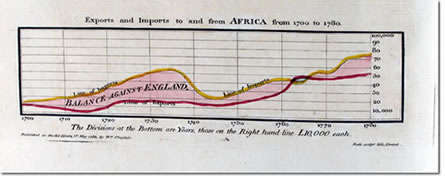
Graph taken from William Playfair, The commercial and political atlas, London, 1786. (DUL ref: Winterbottom K12)
The first leg of the so-called Triangular Trade involved the transport of manufactured goods from Britain to Africa. Goods exported included guns and ammunition, iron goods, glassware and cloth. As can be seen from this graph, these amounted to a considerable amount but Britain was still a net importer for the duration of the 18th century.
Map showing the slave coast of West Africa
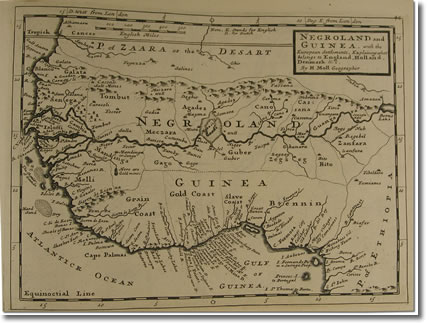
Map showing the area of Africa exploited by the Europeans for slaves, gold and grain. Taken from Atlas minor: or A new and curious set of sixty-two maps, in which are shewn all the empires, kingdoms, countries, states, in all the known parts of the earth by Herman Moll, 1736 (DUL ref: Maltby L+ 11/2)
This map, showing the west coast of Africa, was published in 1736. It shows quite clearly how this part of Africa was seen as a place to be exploited for its grain, its gold and its people.
The trade in slaves
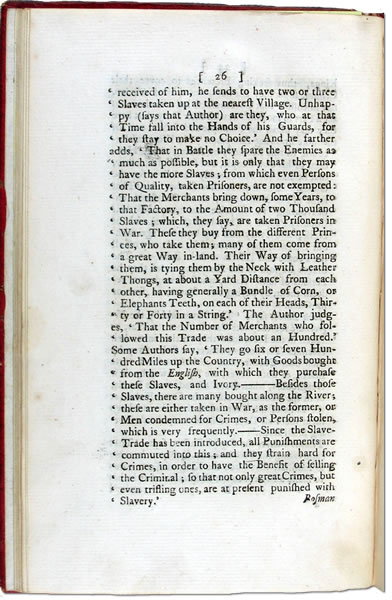
Extract describing the trade in slaves from A short account of that part of Africa, inhabited by the negroes by Anthony Benezet, 1768. (DUL ref: Bamburgh O V 15)
Slaves were procured by various means. Although ‘snatch and grab’ raids did occur, slaves were also brought from much further inland to be sold to the slave traders on the coast. This account by Anthony Benezet, tells how they were brought to the coast. Benezet also mentions that many of the slaves had been prisoners of war or prisoners. Enslavement as a punishment had been traditional in certain parts of Africa but it became much more common after the Europeans started to trade in slaves. Some African rulers were tempted by the promise of guns, gold and other commodities offered by the European traders and were prepared to offer slaves in exchange. Demand outstripped supply and so new crimes and greater punishments came into being.
The enslavement of African people
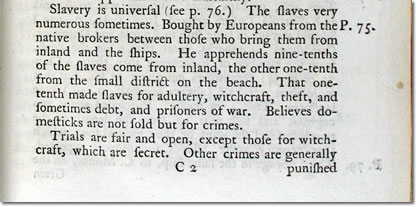
Extract of evidence given by Mr Knox to a Select Committee of the Privy Council. Taken from Abridgement of the Minutes of Evidence taken before a Select Committee on the Slave Trade, 1789. (DUL ref: Bamburgh O V 13)
This account of the reasons why people were enslaved was given to the Select Committee of the Privy Council on the Slave Trade by Mr Knox. Although of an entirely different persuasion from Benezet (Knox was a slave ship captain), his evidence also demonstrates that many Africans were enslaved as a punishment just so they could be sold on to the slave traders.