
Life on the plantations
A plantation owner’s view
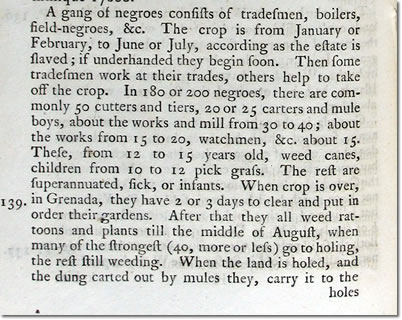
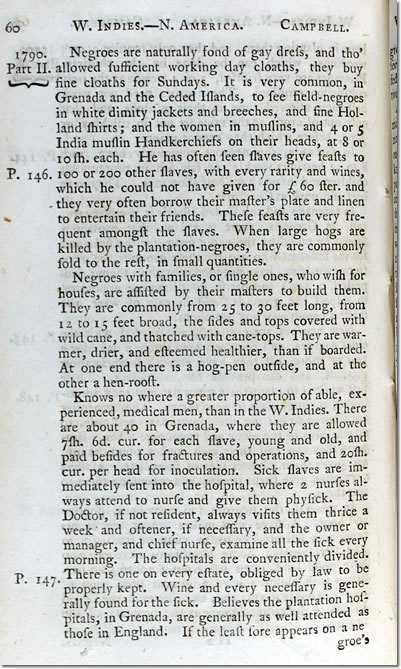
Extract of evidence given by Alexander Campbell to a Select Committee of the Privy Council. Taken from Abridgement of the Minutes of Evidence taken before a Select Committee on the Slave Trade, 1789. (DUL ref: Bamburgh O V 13)
This account given by Alexander Campbell to the Select Committee of the Privy Council on the Slave Trade paints a warm picture of slave life. Not only is their working life far from harsh but they are well dressed and disposed to feasting. It will be of little surprise therefore, to learn that Campbell was a plantation owner owning 14 estates and many hundred slaves.
A traveller’s view

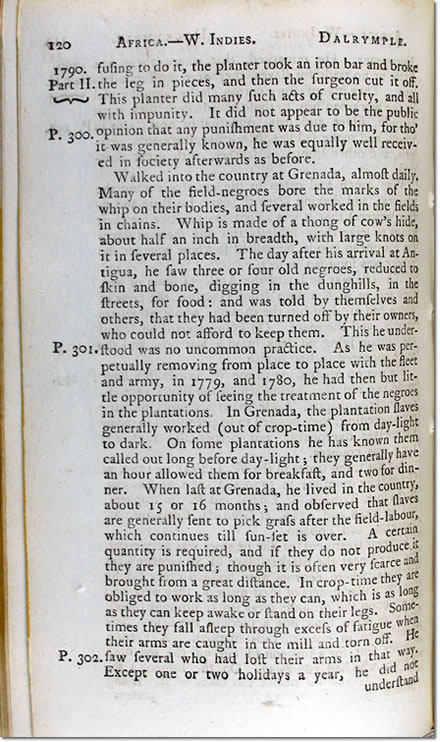
This account given by William Dalrymple to the same Select Committee paints a very different picture to that painted by Mr Campbell. Dalrymple’s evidence suggests that cruelty to the slaves was commonplace and extreme. Slaves would be harshly punished for the most trifling offence and were worked to the point of exhaustion.
The cruel treatment of slaves

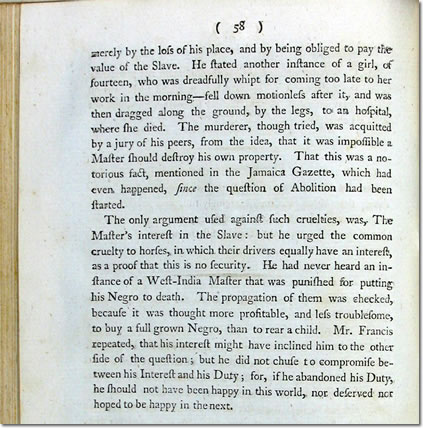
As already seen, cruelty towards slaves was commonplace. Indeed, from the mid-seventeenth century, the harsh treatment of slaves was made official as each slave region started to produce a ‘slave code’. Although the codes differed from place to place, they shared many characteristics. Slavery was made a permanent condition, and it was hereditary (passed down via the mother); slaves were not allowed to enter into any contracts or own any property; they could not leave their owner’s property without permission; they could not bring any legal action against whites; and they could not marry. Any slave found guilty of breaking the slave code could be whipped, branded, imprisoned or put to death. The treatment of slaves was so harsh that it has been estimated that up to one-third of all slaves died as a result of over-work or the punishments used to enforce the work regime.
This speech was made by Philip Francis, MP for Bletchingley, in the debate on a bill to abolish slavery in 1791. Although there was much popular support for the abolitionists, the Bill was still defeated.
The punishment of slaves
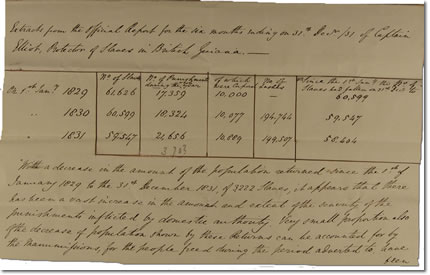
Extract of report submitted by Charles Elliot detailing the punishment of slaves. (DUL ref: GRE B140/C1)
It had been the hope of many anti-slavery campaigners that after the trade in slaves came to an end in 1807, masters would be encouraged to treat their remaining slaves better. It was thought that unable to replenish their stock, they would take a greater interest in the welfare of their existing slaves. This proved a false hope as this document shows. This report was submitted by Captain Elliot, Protector of Slaves in British Guiana (now Demerara) and details the number of punishments meted out, indicating how many of these were corporal punishments and the number of lashes.
The mistreatment of slaves
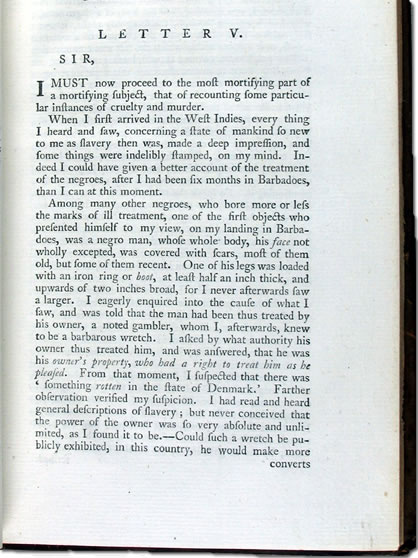
Many of the documents emanating from the plantation owners demonstrate that they thought of their slaves as property not people. This attitude is reflected in this letter written by William Dickson, an anti-slavery campaigner and former private secretary to the Governor of Barbadoes. He writes that he saw a slave who had obviously been mis-treated and asked him why his owner had behaved in that way. The slave’s reply was chilling – that he was his master’s property and therefore had a right to treat him anyway he saw fit.
The cruel separation of families
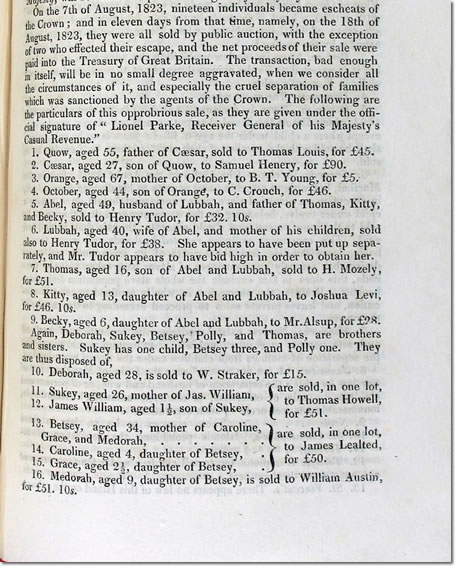
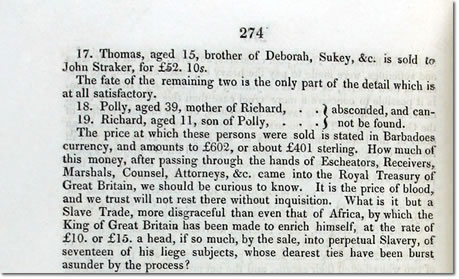
Slave sales did not just happen on the arrival of the slave ships in the West Indies. They could also happen if an estate was sold or escheated. This could lead to the heartbreaking situation of families being separated. Since slaves were not officially permitted to marry, they were not recognised as husband and wife. Children of a good working age could also be sold separately as they were worth a considerable amount of money. As can be seen from this source, it was not uncommon for children as young as six to be separated from their family. Once taken to a different plantation, it was unlikely that they would have been able to maintain contact.