
Why did the slave trade start?
A Bill of Sale, c 1776
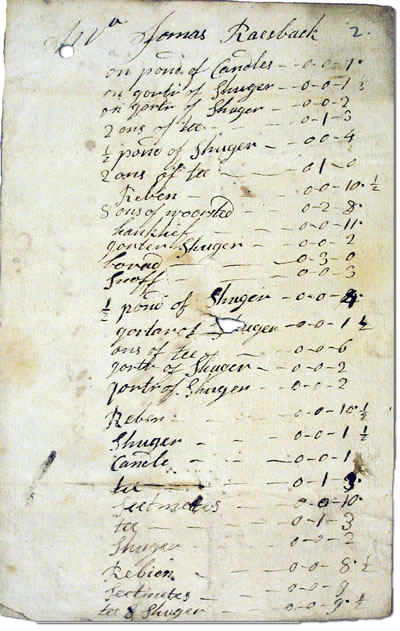
Bill of Sale detailing the purchase of sugar and other items. (DUL ref: CCB B/218/34/2)
This bill of sale details purchases made from T[h]omas Raesback by Sarah Bainbridge in the 1760s. It shows quite clearly how often sugar was bought at this time.
Sugar had been introduced to Europe by returning Crusaders but it was not until the 17th century when it started to be grown in the Caribbean, North America, Cuba and Brazil that it became popular. Its growing popularity was reflected in its profitability and the number of plantations producing sugar increased. This, in turn, increased demand for labourers.
Inventory of John Walker, a Durham merchant, 1691

This inventory, dating from 1691, lists all the goods and chattels belonging to John Walker, a merchant living in Durham. This extract shows what Walker had for sale in his shop. Prominent amongst the items are sugar and tobacco. It is more than likely that both these products were produced by slave labour. Transporting slaves from Africa to the Americas had started in the early 17th century by Dutch traders but they were shortly followed by Britsh traders. Indeed, in 1672 the Royal African Company was establised specifically to trade in slaves and other commodities from Africa. Between 1672 and 1689 it alone was responsible for transporting 90,000 slaves across the Atlantic.
Extracts from The National and Private Advantages of the African Trade Considered, 1746

Extract from The National and Private Advantages of the African Trade Considered by Malachy Postlethwayt, London 1746. (DUL ref: Winterbottom K 12)

This account is quite clear in its support for the institution of slavery, justifying its existence on many grounds. The main concern of the author is to stress the benefits to Britain of trading in slaves although he also states his belief that slavery was better for the slaves. The author of this book was Malachy Posthlethwayt, an economist who promoted slavery as a means of hindering the independence of the American colonies.